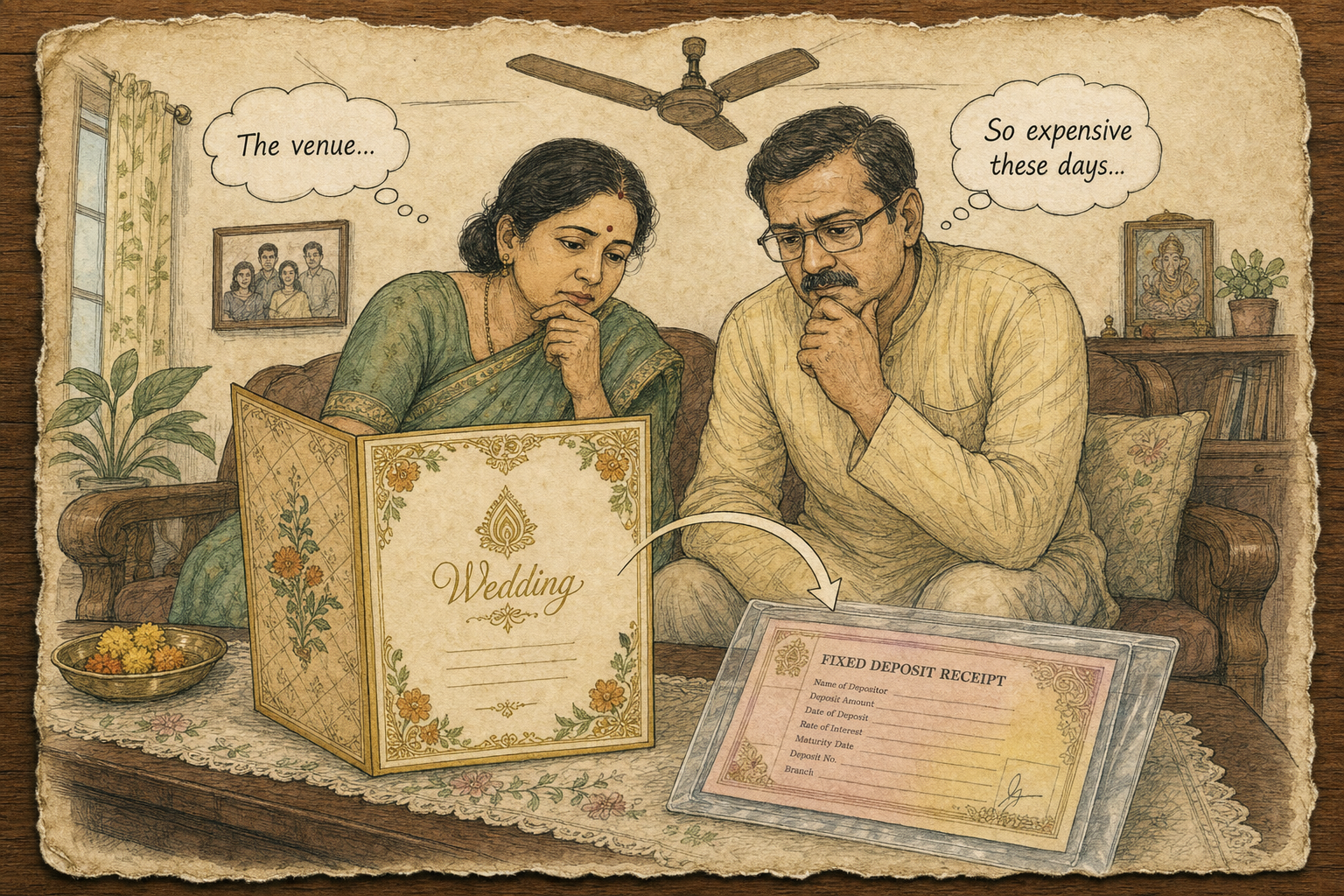
A wedding card arrives at your house.
Your mother looks at it. Your father looks at it. Somebody mentions the venue. Somebody else mentions how expensive weddings have become. And then, almost magically, the conversation drifts toward Fixed Deposits.
This is one of those uniquely Indian financial phenomena that nobody talks about. The bride and groom are getting married. The caterer is getting paid. The photographer is getting paid. The banquet hall is getting paid. Yet somehow, sitting quietly behind the scenes of millions of Indian weddings is a Fixed Deposit that started its life years, sometimes decades, earlier.
Nobody celebrates the FD. Nobody thanks the FD. Nobody frames a photo of the FD and hangs it on the wall. Yet if Indian weddings had end credits like movies, Fixed Deposits would deserve a producer credit.
The funny thing is that wedding money behaves differently from normal money. Normal money is incredibly vulnerable. Leave ₹5 lakh sitting in a savings account and suddenly life discovers a hundred uses for it. The house needs renovation. The scooter is getting old. The business needs a little capital. A cousin has an opportunity. A relative has a suggestion. Indian families have known this for generations. Which is why wedding money was often hidden from the family by the family itself.
The hiding place was usually spectacularly boring.
A Fixed Deposit.
Simply because it created distance between the money and temptation. An FD was the financial equivalent of putting sweets on the highest shelf in the kitchen. Technically accessible. Practically protected.
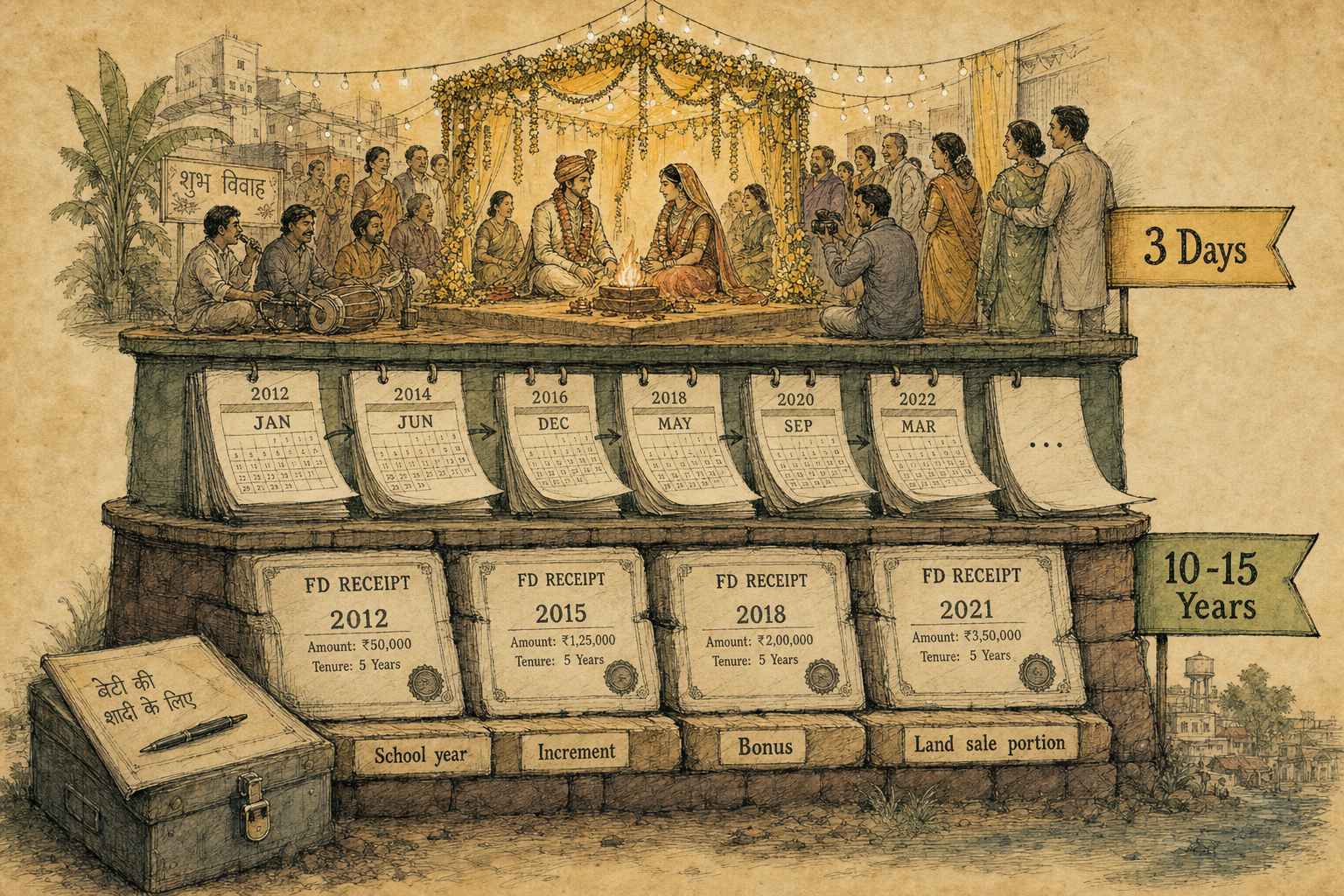
What's fascinating is how early this process begins. In many households, wedding planning starts long before anyone would admit they're planning a wedding. A child enters school. An FD gets opened. A salary increment arrives. Another FD. A year-end bonus comes in. Another FD. Sometimes a plot of land gets sold and a portion quietly disappears into a deposit that nobody is supposed to think about for the next ten years.
If you add up all these small decisions, something interesting emerges. Indian weddings often look expensive because people see the final event. They see the lights, the decorations, the jewellery, the food, the endless photography, and the relatives who appear from every corner of the country. What they don't see is the decade of preparation hiding underneath it. The wedding itself may last three days. The funding often takes ten or fifteen years.
That's why conversations around wedding expenses can be strangely calm in some households. The money wasn't arranged last month. It wasn't borrowed in a panic. It wasn't discovered at the last minute. It has been sitting there for years, quietly collecting interest while everybody got older.
There is something very Tier-2 India about this approach to money. It lacks the excitement of financial influencers and the glamour of investment trends. Nobody is making YouTube thumbnails about the FD opened in 2012 that helped pay for a wedding in 2025. Yet millions of families have relied on exactly that system.
In a strange way, the Fixed Deposit became a bridge between two moments in time. The day a parent decided to start preparing, and the day the wedding finally arrived. Everything in between was just patience.
And perhaps that's why Fixed Deposits became so deeply connected to Indian weddings. Because they matched the way many Indian families think. Big events are rarely funded overnight. They're funded slowly, quietly, and years before anyone else notices.
The wedding lasts a weekend.
The preparation often lasts a decade.