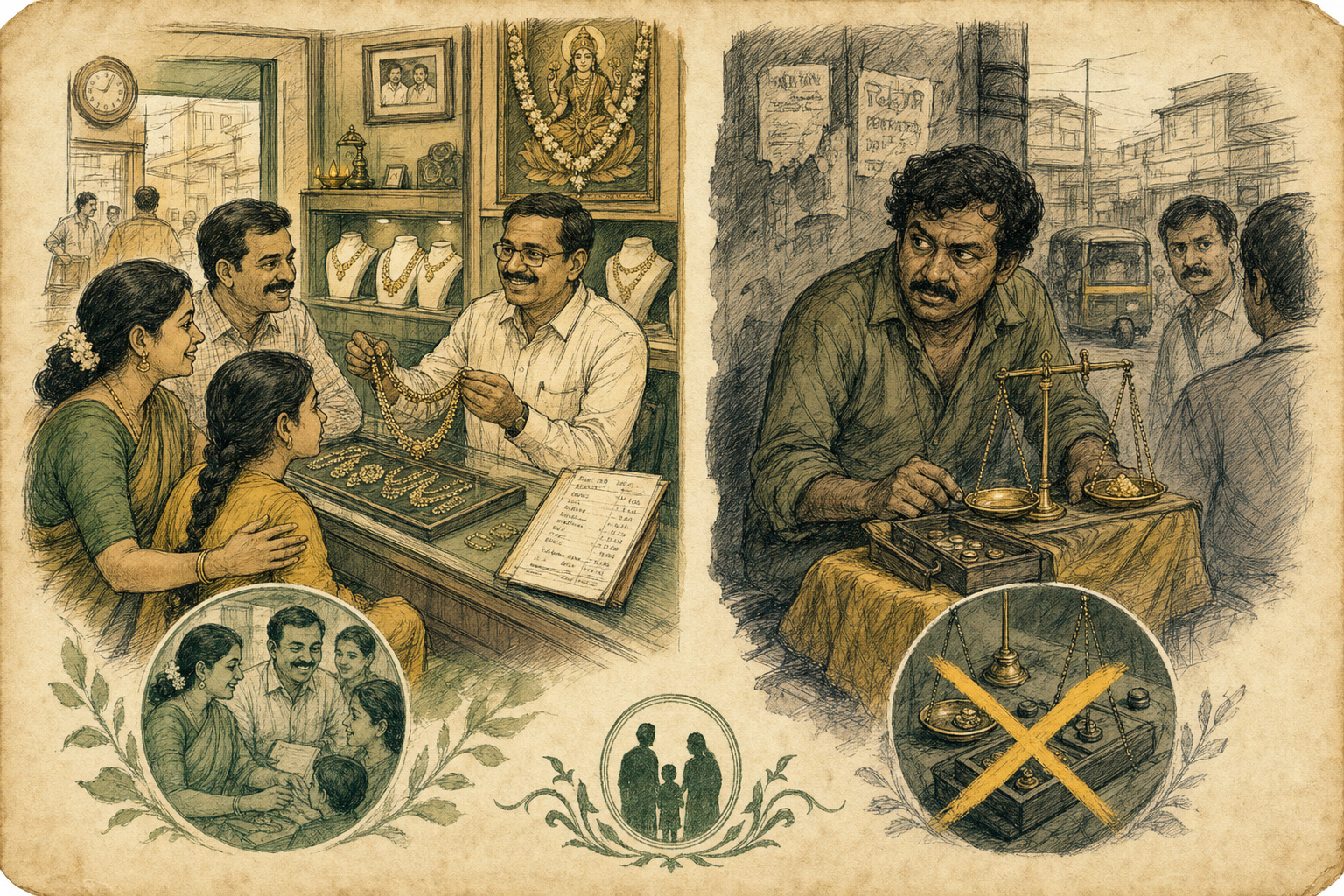
Nobody teaches you how gold buying works in a Tier 2 Indian family.
There is no PDF guide. No fintech founder explaining it on a podcast with LED lighting and a minimalist beige background. You just grow up around it. You sit silently in jewellery shops as a child. You watch adults negotiate like geopolitical diplomats over making charges. You slowly understand the rules without anybody formally saying them out loud.
And there are rules. Very specific ones.
The first rule is about the jeweller.
You do not “try out” random jewellery shops in a small town the way people try cafés. You have a jeweller. Usually the same one your family has been dealing with for years. Sometimes decades. Sometimes so long that your mother still refers to the owner as “beta” even though the man is now 47 years old with blood pressure issues.
That relationship matters more than outsiders realize.
Because when Indian families buy gold, they are not only buying gold. They are buying trust. Trust that the weight is correct. Trust that the purity is real. Trust that if something goes wrong later, the shop will still exist. Trust that when you come back to sell or exchange the piece, nobody suddenly behaves like you are strangers meeting for the first time.
A new jeweller may offer better designs. Better lighting. Better Instagram presence. Still risky.
Your family jeweller already knows your people. That itself has value in India.
The second rule is about timing.
Gold is rarely bought randomly because “the market looks attractive.” Gold buying in India is attached to occasions. Dhanteras. Akshaya Tritiya. Weddings. Engagements. Birthdays. Sometimes just “acha time chal raha hai.”
People think this is only superstition. It is not.
It is also a savings system disguised as culture.
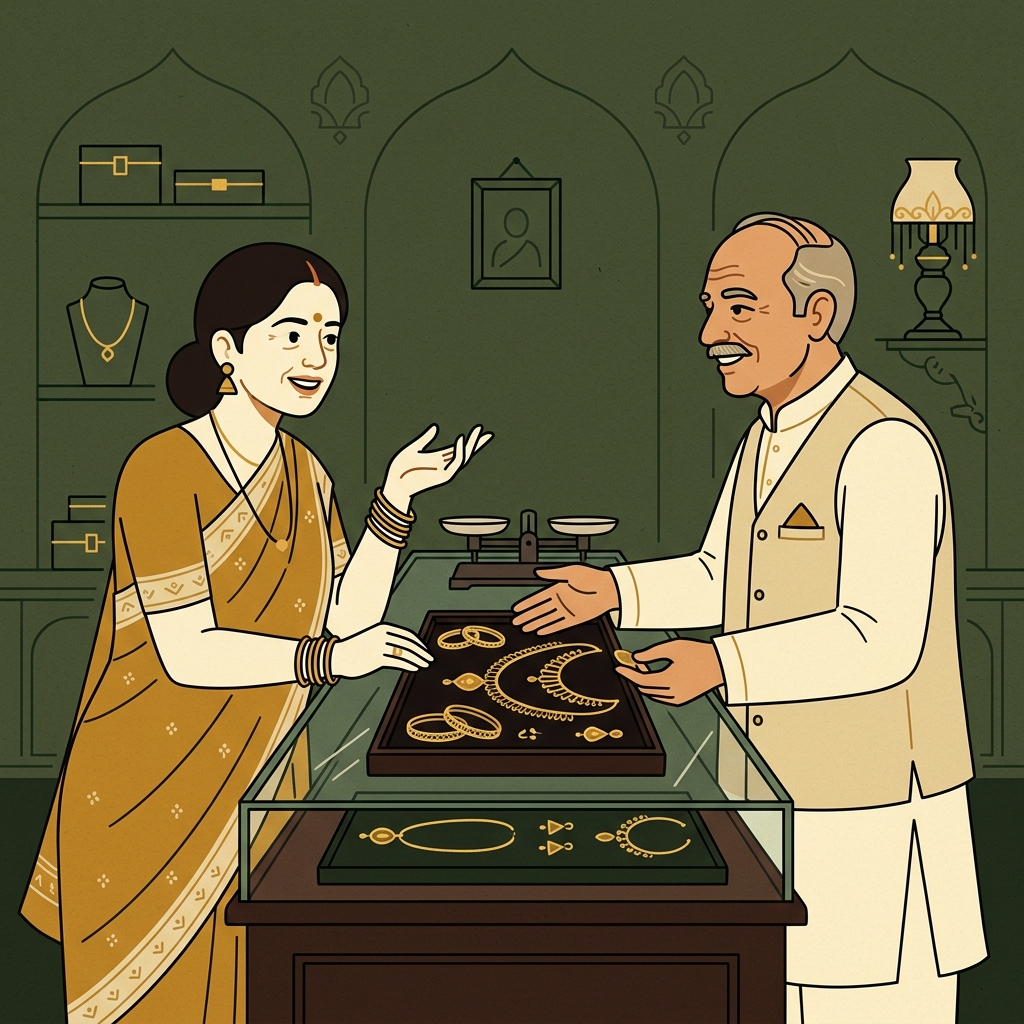
Indian families psychologically save better when money is attached to an event. A reason. A ritual. You slowly accumulate funds over months, then convert them into gold during a meaningful moment. Which is why many families that struggle to save cash consistently somehow manage to keep accumulating gold over decades.
The third rule is where the real battle begins.
Making charges.
Not gold price. Everybody already knows today’s gold rate because every jewellery shop in India displays it like breaking news. The actual negotiation starts afterwards.
And suddenly your otherwise calm mother transforms into a criminal lawyer cross-examining a hostile witness.
“Hum itne saalon se yahin se le rahe hain.”
That sentence alone has probably altered the Indian jewellery economy permanently.
Because in small-town India, loyalty gets monetized. A family that has purchased from the same shop for twenty years does not get treated the same way as somebody walking in randomly from another colony.
And honestly, that is not corruption.
That is how trust gets priced in relationship-driven markets.
The fourth rule is about selling.
You do not casually sell gold to strangers. Ideally, you go back to the same jeweller. Because the moment you walk into an unknown shop, the entire power balance changes. Now you have to prove purity. Prove purchase. Prove everything.
Your jeweller already knows the piece. Maybe his father sold it originally. Maybe he remembers the wedding where it was bought. That history matters during resale in ways modern finance people struggle to understand.
And the fifth rule. Probably the most important one.
You do not discuss how much gold exists at home.
Not casually. Not publicly. Not with relatives who suddenly become emotionally close during difficult financial periods.
The gold in Indian households exists in a strange category between wealth, emergency fund, and classified information.
Everyone knows it exists. Nobody fully discusses it.
Because deep down, Indian families do not treat gold like jewellery.
They treat it like a silent backup.
Something that sits quietly for years and suddenly becomes important when life stops behaving properly.
And maybe that is why gold still survives every modern prediction about becoming “outdated.”
Because outside financial apps and investing culture, millions of Indian families still trust things they can physically hold in their hands.