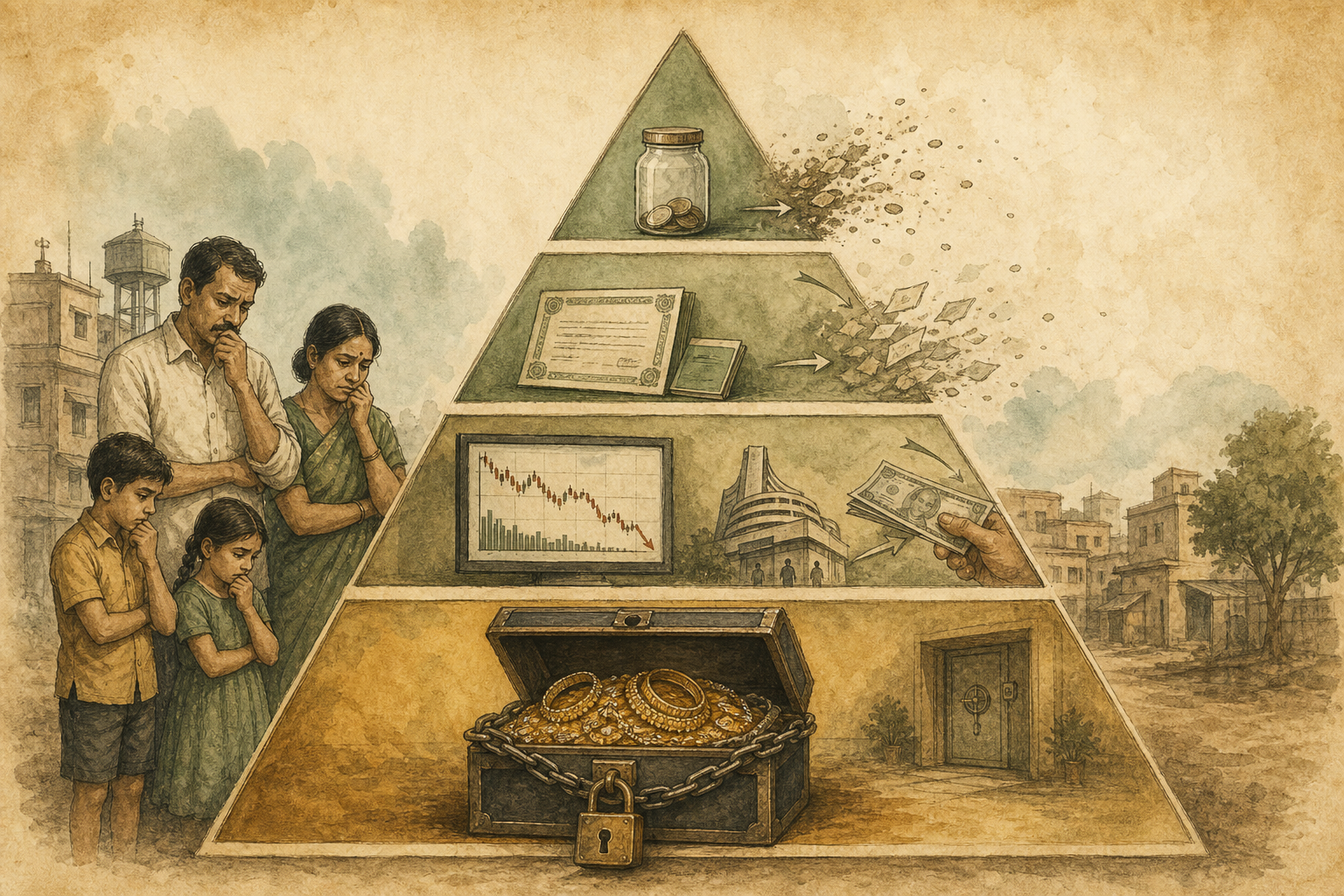
If you examine the financial balance sheet of an Indian family during a major crisis, you will observe a highly specific, unwritten liquidation hierarchy.
It does not match anything taught in modern business schools. It completely ignores modern portfolio theory, capital gains tax optimization, and asset efficiency models.
It is an emotional ranking of assets. And at the absolute bottom of that ranking is physical gold.
When a crisis arrives, the first things to go are bank savings. You empty the savings account. You pause your recurring deposits. You spend whatever liquid cash exists inside the house.
If the crisis deepens, you look at financial assets. You break a safe fixed deposit early, accepting the minor interest penalty. You exit stock market holdings or redeem mutual fund units in a few clicks.
If the pressure continues, you look at real estate. You list a secondary plot of land for sale, or you look at borrowing against your commercial shop front.
But you do not touch the gold.
Because in middle-class Indian households, selling gold is not viewed as a simple financial transaction. It is viewed as an admission of absolute defeat.

It represents the ultimate collapse of family insulation. The moment the gold enters a stranger's scales to be liquidated permanently, it signals to the local community that the household has run out of options.
So families will borrow from relatives, take high-interest local loans, or compromise their daily living standards to keep the gold locked safely inside the house.
If the family absolutely must leverage gold, they will choose a gold loan (pledging the gold) rather than selling it.
Pledging gold is acceptable because it represents a temporary setback. The gold remains yours; it is simply waiting in a vault until the business season recovers, or the emergency passes. It represents hope of recovery.
But selling the gold? That is permanent.
It is the final shield of honor. It is the wealth of the mother, the security of the children, and the physical legacy of three generations.
And that is why, during every economic downturn, other markets freeze or panic, but the gold loan counters are always filled with families quietly managing their survival with dignity intact.
Because they know that as long as the gold is safe, the family's foundation remains unbroken.