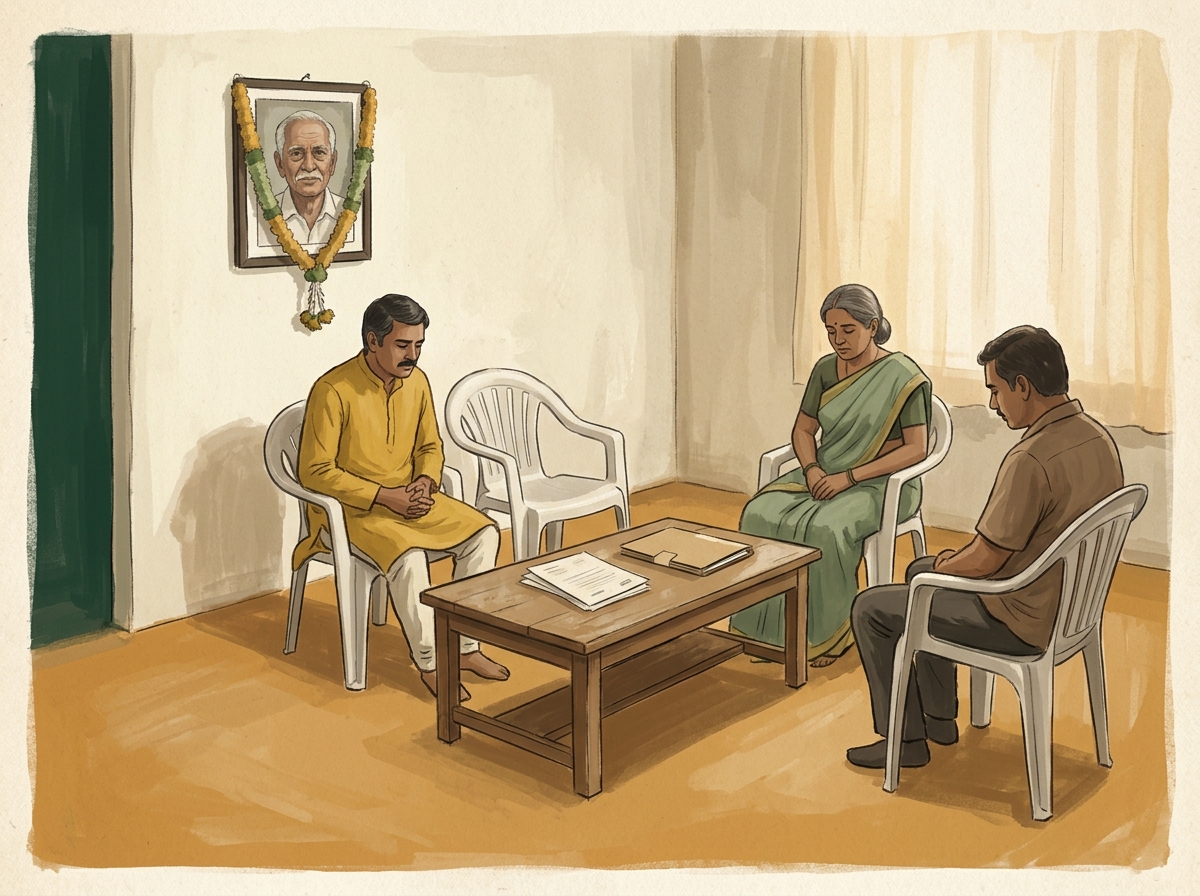
There is a very specific type of silence inside Indian families after funerals.
Not grief silence.
Administrative silence:
- Who has the papers?
- Whose name is the property in?
- Did he leave a will?
- Who knew the locker password?
- Who paid for the construction?
- What exactly was “promised” to whom?
And somewhere inside that silence, the math quietly begins.
Not in every family. But in enough families that almost every Indian adult has heard at least one horror story involving siblings who no longer speak because of property.
A shop.
A house.
A floor added twenty years later without paperwork.
Agricultural land near the highway.
An old ancestral property suddenly worth crores because the city expanded around it.
Indian property disputes are their own genre of family breakdown.
And the strange part is, the fight is rarely just about the property itself.
It is about memory:
- The brother who stayed back and handled the business while the other one moved away for studies
- The daughter who was told “shaadi mein sab de diya tha”
- The son who financially supported the parents for fifteen years and quietly assumed that would matter later
- The uncle who claims something was verbally promised in 2004 during a family dinner nobody else even remembers properly
Indian families run on emotional accounting for decades.
Then suddenly somebody dies and everyone expects legal accounting to solve it cleanly.
It almost never does.
Because property in India is not just wealth.
It is identity. Control. Respect. Proof that a family built something tangible in this world.
Especially in Tier 2 India, where property ownership often represents thirty or forty years of sacrifice compressed into one physical asset.
Which is why property fights become so vicious.
You are not arguing over square footage anymore.
You are arguing over recognition:
Who sacrificed more.
Who deserved more.
Who was valued more by the parents.
Who “really” built the family.
And honestly, the legal system makes everything worse.
Property cases in India can outlive the people fighting them. Children inherit court cases from parents. Lawyers inherit clients from their fathers. Entire adult lives disappear inside hearings, adjournments, missing documents, mutation issues, and arguments over verbal promises made by dead people.
Meanwhile the property itself just sits there silently while the family collapses around it.
The cruel irony is that many parents genuinely believe their children will “figure it out peacefully” after they are gone.
Which is probably one of the most financially dangerous assumptions in India.
Because Indian families avoid uncomfortable conversations until the discomfort becomes legally irreversible.
Nobody wants to discuss wills. Nobody wants to discuss division openly. Parents think writing things down feels cold or distrustful.
But the alternative is much colder.
A funeral lasts twelve days in India.
And a property dispute? Twelve years or more.